
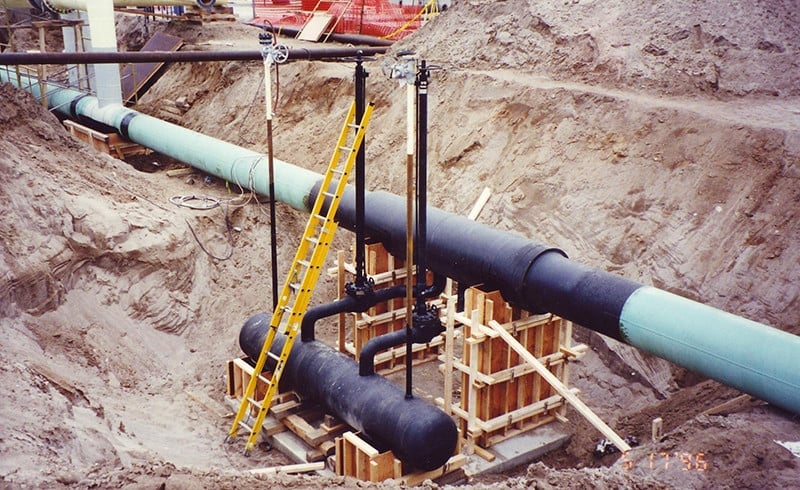
 Innopipe is our piggable drip and gas separator that removes over 99% of liquids in your pipelines. While Innopipe offers numerous benefits that we’ll discuss below, there is an important aspect related to safety that is worth noting:
The prevention of corrosion in your pipelines.
The National Pipeline Mapping System (NPMS), which is managed by the Pipeline and Hazardous Materials Safety Administration (PHMSA), serves primarily as a geographic database of pipeline locations. It allows authorized government officials and operators to see where the pipelines are located.
The raw PHMSA incident data – which the NPMS is based on – provide clear statistics and commentary on the severity of corrosion as a cause of pipeline accidents.
Here is a summary of the statistics on pipeline corrosion and its resulting hazards, drawn from data analysis.
The Role of Corrosion in Pipeline Accidents
Based on PHMSA’s tracking of incidents across the U.S. hazardous liquid and gas transmission pipeline network, corrosion can be a significant cause of failure. The data typically breaks down corrosion into two categories: External and Internal.
1. External Corrosion
External corrosion (caused by environmental factors like soil conditions, poor coating, or failed cathodic protection) is generally a more frequent issue than internal corrosion.
Hazardous Liquid Pipeline Failures: PHMSA data consistently shows that external corrosion is one of the top categories for hazardous liquid pipeline failures, often accounting for approximately 9% to 10% of all reported incidents.
Significance: While equipment-related issues (valves, pumps, fittings) may account for a larger total number of incidents, corrosion often leads to failures that have severe consequences due to the loss of containment and the release of hazardous material into the environment.
2. Internal Corrosion
Internal corrosion is typically caused by corrosive products being transported, or by water and CO2 or H2S (hydrogen sulfide) settling in the line.
Lower Frequency, High Impact: Internal corrosion incidents are usually less frequent than external corrosion, but when they do occur, they indicate a significant problem with the material being transported or the internal protective measures (like inhibitors).
From a risk management perspective, corrosion remains a major priority because it degrades the physical structure of the pipe wall over time, leading to catastrophic failure if not addressed.
Let’s discuss how Innopipe addresses these specific concerns.
How Innopipe Helps
The Innopipe piggable drip and gas separator was designed to address a core problem in natural gas pipelines that directly contributes to internal corrosion.
As natural gas travels through the pipe, it cools, causing water vapor to condense into liquid water.
These corrosive liquids tend to collect in the lowest points of the pipeline profile (sags, low elevation areas), forming slugs. In addition, changes in a pipeline’s operation, such as volume or velocity decreases change how the line sweeps itself compared to past operations. Case studies of such instances can be seen on the Trusted Pipeline Advisor page. These localized pockets of liquid, and often entrained solids as well, especially if they are highly acidic (low pH), become primary sites for accelerated pitting corrosion, which eats away the pipe wall from the inside. Recent Pipeline Technology Conference lectures confirm that these MOC issues continue to be issues for gas pipeliners worldwide.
The design of Innopipe allows pipeline owners to remove liquids without the need for expensive slug catchers. Innopipe stands out from traditional designs by effectively addressing the prevalent annular flow pattern in higher-velocity gas transmission and gathering pipelines. Our continued R&D ensures increasingly greater instantaneous slug rates can be managed without upsets in either the Innopipe Piggable Separator or the 2 or 3 phase Collection Reservoir below it.
Innopipe is also less expensive to build and have much broader operating parameters than most gravity-inducing designs. We give slow moving water and fast moving gas the preferential paths they naturally take, without force, reducing back pressure and horsepower loss in the process.
Innopipe Results
- Better pipeline integrity;
- Minimized corrosion issues;
- Reduced use of inhibitors;
- Black powder reduction/ elimination;
- Extended pipeline life;
- Liquid slug reduction & control;
- Reduced pigging;
- Improved gas plant and pipeline operations and predictability due to more consistent operations.
Contact
Please contact us directly for all global inquiries.
OilPro Oilfield Production Equipment
Tel +1 403 215-3373
Please click to view the short video that visually explains how Innopipe works.